Gym equipment classes are there to bring order to a crowded and seemingly jumbled fitness market. Regardless of whether you are creating a home gym, equipping a business gym, or renovating a studio, knowing the classification of gym equipment allows you to spend reasonably, to train efficiently, and to save a lot of money on regretful purchases.
This manual defines the key types of gym equipment utilized throughout the United States, the way its specific equipment type operates, who it targets, and how to select the most suitable combination of equipment depending on intentions, space, and budget.
Over Latest Post: CSM $15 Gym Membership: Pricing, What’s Included, Locations in the USA, Pros, Cons, and How to Join
Gym Equipment Categories Explained
What Are Gym Equipment Categories?
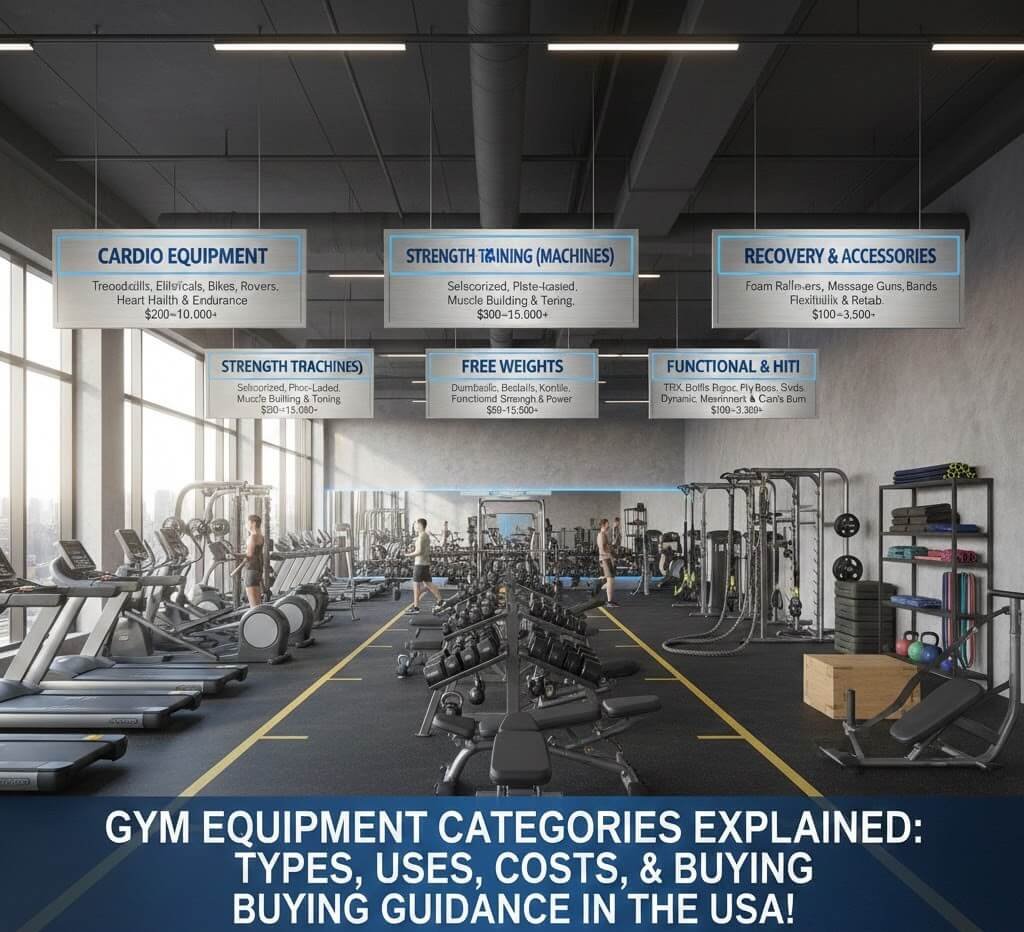
Gym equipment categories refer to standardized groupings of fitness equipment in accordance with purpose, movement type, and training effect. These are the key types: strength training, cardio, functional training, flexibility and mobility, recovery and rehabilitation, and accessories.
Fitness professionals, equipment manufacturers, and gym owners use these categories to create balanced training environments and to make equipment match the needs of the users.
Why Gym Equipment Categories Matter
The decision to select equipment without knowing categories usually results in the case of overbuying, underutilizing machines, or creating an unequal apparatus.
Categorization will help you to:
- Equipment to fit individual fitness objectives.
- Allocate space efficiently
- Control costs
- Reduce injury risk
- Arrange gradual training courses.
- Select home and commercial-grade equipment.
In the case of businesses, there are also categories that dictate procurement, maintenance planning, and member satisfaction.
Over the latest post: What’s a PR in Gym? Meaning, Examples, How to Track It, and How to Improve Safely
The Main Gym Equipment Categories
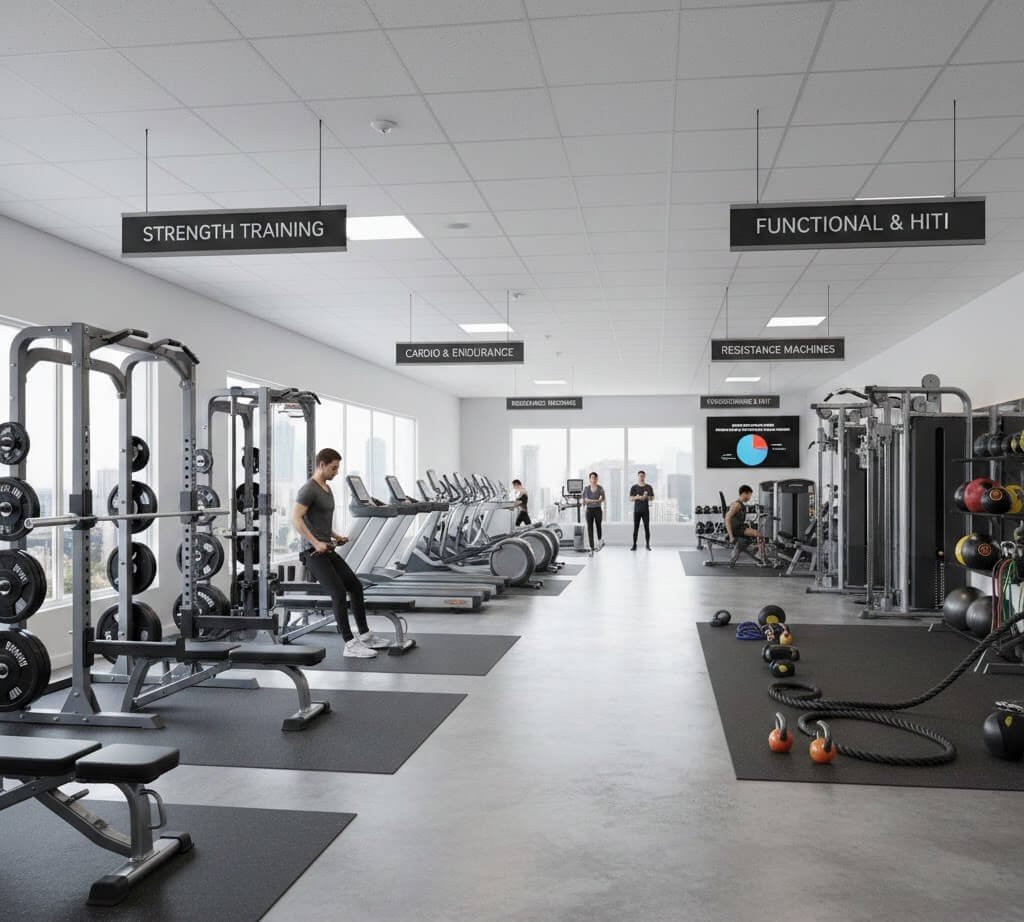
Strength Training Equipment
Strength training equipment is designed to build muscle, increase bone density, and improve overall force production through resistance.
Common examples include
- Dumbbells and barbells
- Weight plates
- Power racks and squat racks
- Selectorized machines
- Plate-loaded machines
Subcategories
- Free weights: Dumbbells, barbells, kettlebells
- Selectorized machines: Pin-loaded machines with guided movement
- Plate-loaded machines: Machines that use Olympic plates
Pros
- Supports progressive overload
- Highly effective for muscle and strength gains
- Scalable for beginners to advanced users
Cons
- Requires proper technique
- Needs more space and flooring support
Best for
- Home gyms focused on strength
- Commercial gyms
- Athletic training facilities
Cardio Equipment
Cardio machines improve cardiovascular health, endurance, and calorie expenditure.
Common cardio machines
- Treadmills
- Stationary bikes (upright and recumbent)
- Ellipticals
- Rowing machines
- Stair climbers
Why it matters
The cardio devices assist in the heart health, weight management, and conditioning programs. It is one of the first types of users to search in a gym.
Best for
- Weight loss programs
- Rehabilitation settings
- Commercial gyms with broad member bases
Over the Latest Post: Should You Work Out After Botox? Safe Timeline, Risks, and Expert Recovery Guide

Functional Training Equipment
The functional training devices are concentrated on the real-life movement pattern, not on individual muscle activity.
Examples
- Kettlebells
- Suspension trainers
- Medicine balls
- Plyometric boxes
- Battle ropes
Benefits
- Improves balance and coordination
- Enhances sports performance
- Builds strength through movement patterns
When to prioritize
- Limited space environments
- Athletic or group training
- Studios and boutique gyms
Flexibility and Mobility Equipment
This category supports joint health, range of motion, and movement quality.
Common tools
- Yoga mats
- Resistance bands
- Stretch straps
- Foam rollers
Who it’s for
- Beginners
- Older adults
- Mobility-oriented training and yoga.
- Injury prevention programs
Recovery and Rehabilitation Equipment
Often overlooked, recovery and rehab equipment plays a major role in long-term training success.
Examples
- Massage guns
- Balance boards
- Compression tools
- Light resistance rehab bands
Why it matters
Recovery equipment decreases the likelihood of injury, enhances training consistency, and aids physical therapy and recovery of the body following a workout.
This category is becoming more widespread in commercial gyms and physical therapy clinics in the USA.
Accessories and Small Fitness Tools
Accessories are compact, affordable tools that enhance training without taking much space.
Examples
- Jump ropes
- Ab wheels
- Grip trainers
- Weightlifting belts and straps
These tools are ideal for home gyms, warm-ups, and finishing work.
Over Latest post: Metal Jungle Gym Complete Commercial & Backyard Guide for Schools, Parks, and Home Playgrounds

Gym Equipment Categories by Use Case
| Use Case | Recommended Categories |
|---|---|
| Muscle building | Strength training |
| Weight loss | Cardio + functional |
| Athletic performance | Functional + strength |
| Rehabilitation | Recovery + mobility |
| Small spaces | Functional + accessories |
Home Gym vs Commercial Gym Equipment
Home Gym Equipment
Home gym equipment is designed for personal use with lower daily volume.
Key traits
- Compact footprint
- Multi-functional designs
- Lower maximum load ratings
- Lower cost
Common mistakes
- Buying commercial machines without space or ceiling clearance
- Ignoring noise and flooring requirements
Commercial Gym Equipment
Commercial equipment is built for durability and heavy usage.
Key traits
- High load capacity
- Reinforced frames
- Compliance with ASTM and ISO standards
- Longer warranties
Who needs it
- Gyms and fitness centers
- Hotels and corporate gyms
- Schools and rehabilitation facilities

How to Choose Gym Equipment by Category
When deciding what category to invest in first, use this framework:
- Define your primary goal
Strength, fat loss, rehab, or general fitness. - Measure available space
Include ceiling height, flooring, and clearance. - Identify users
Individual use, family use, or public access. - Set a realistic budget
Balance core equipment with accessories. - Plan for progression
Choose categories that allow upgrades over time.
Cost Expectations in the USA
Gym equipment costs vary widely based on category and build quality.
General cost logic
- Accessories and bands: low cost
- Free weights: low to moderate cost
- Cardio machines: moderate to high cost
- Commercial machines: high cost
Additional expenses often include delivery, installation, flooring, and maintenance.
Safety, Standards, and Compliance
Quality gym equipment in the USA typically follows:
- ASTM fitness equipment standards
- ISO manufacturing standards
Always consider:
- Load ratings
- Stability and anchoring
- Warranty terms
- Availability of replacement parts
These factors are especially important for commercial gyms and shared facilities.

Common Mistakes to Avoid
- Buying equipment without measuring space
- Over-prioritizing machines over free weights
- Ignoring recovery and mobility categories
- Choosing residential equipment for commercial use
- Skipping warranties and servicing options
Alternatives to Traditional Gym Equipment
Not every fitness setup requires machines.
Alternatives include
- Bodyweight training systems
- Resistance band-only setups
- Outdoor fitness parks
- Digital training platforms
These options are popular for small spaces and minimalist training styles.
Frequently Asked Questions
1. What are the main gym equipment categories?
The core products include strength training, cardio, functional training, flexibility and mobility, recovery and rehabilitation, and accessories.
2. Which gym equipment is best for beginners?
Adaptable dumbbells, resistance bands, a bench, and simple cardio equipment are the most helpful for beginners.
3. What equipment do commercial gyms typically use?
The strength machines, free weights, cardio machines, and functional training zones that are used in commercial gyms are constructed using commercial-grade equipment.
4. Is functional training equipment necessary?
This is not compulsory, but it enhances quality of movement, balance, and versatility, particularly in constrained areas.
5. How much does gym equipment cost in the US?
Accessories are cheap, and commercial-grade equipment is expensive depending on the category and quality.
Conclusion
Types of gym equipment offer an efficient system to construct an efficient fitness area. Different categories have various mechanisms of operation, and they also have their own strengths and weaknesses and can be used to build a gym that is focused on your objective and has space and meets your financial needs without excessive spending.
